Unraveling the Quantum Chess Mystery: Challenge of Quantum Consciousness in a Game of Chess
The Penrose Institute, a new research organization focused on the intersection of physics and human consciousness, has announced that it will release additional puzzles in the coming weeks. The institute, founded by Nobel laureate Sir Roger Penrose, invites both human players and AI systems to engage with these puzzles, with solutions submitted via email.
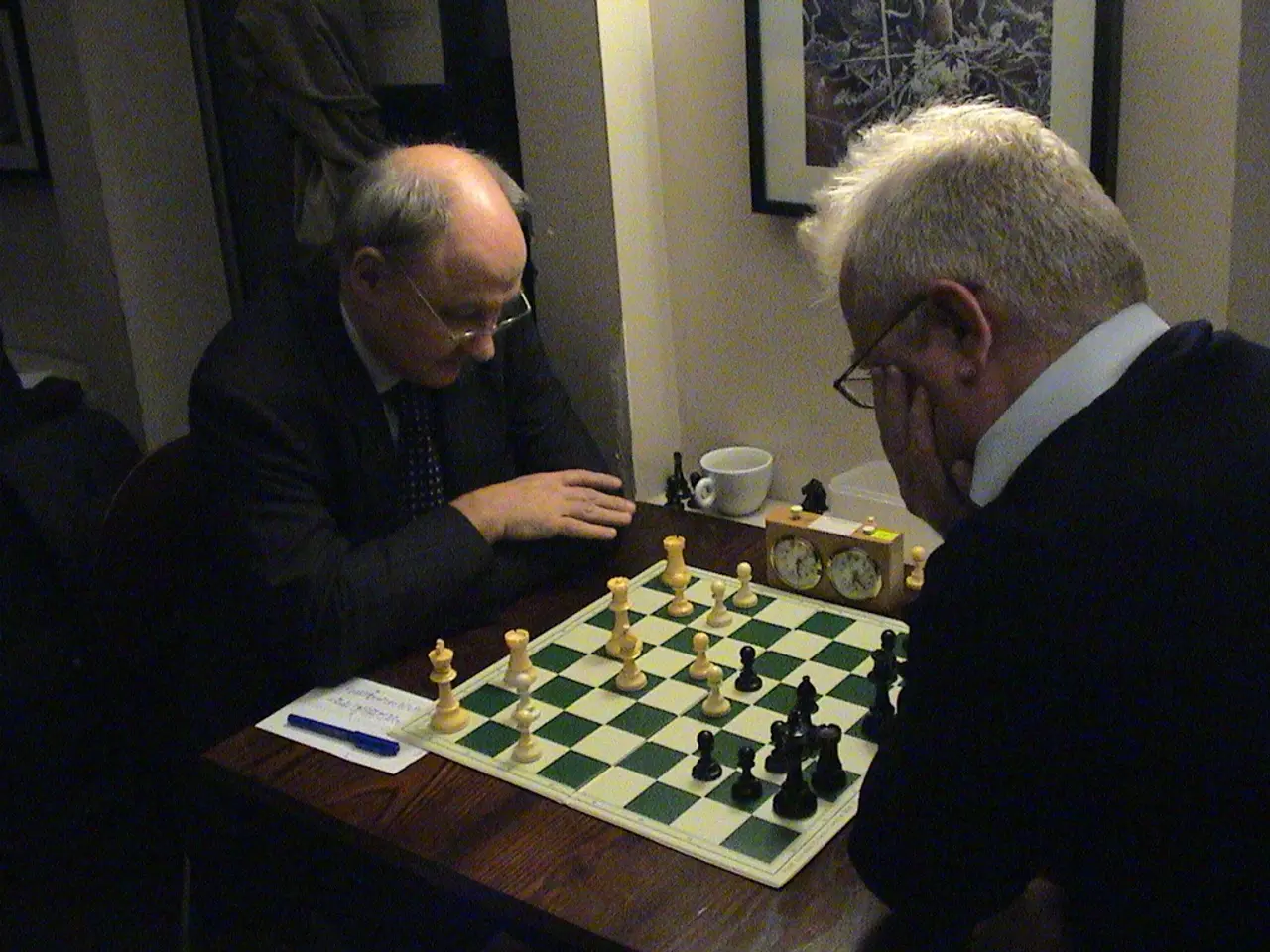
One of the puzzles under scrutiny is a chess puzzle designed by Sir Penrose himself. This puzzle, known for its deep conceptual challenge rather than a conventional solution, has already made headlines as a grandmaster-level chess player has managed to defeat a chess computer on a Grand Master 2600 ELO setting using the solution they submitted to the Penrose Institute.
The chess puzzle is constructed in such a way that it can lead to a draw or even a win, despite appearing to be a hopeless position for White. The process of winning the game against the computer, however, seems to have been somewhat surprising and dull in terms of strategy for the player.
The Penrose Institute's research could demonstrate that the human brain functions not merely as a vast supercomputer but may also exhibit quantum effects that extend beyond current scientific understanding. This is in line with Sir Penrose's broader philosophical arguments, which question whether human consciousness and intelligence (including pattern recognition and creativity, as in chess puzzles) can be fully replicated by computational algorithms.
It's important to note that there is no specific, publicly documented chess puzzle solution created by Sir Penrose in the common chess literature or databases. As such, any chess puzzle linked to Penrose would likely serve as a conceptual or philosophical challenge to AI rather than a standard chess problem with a known solution.
The Penrose Institute has acknowledged receiving the player's solution and expressed appreciation for their brain-stimulating efforts. Another chess puzzle has been presented, taken from the final play of the World Chess Championship. The institute is inviting participants to solve this puzzle, which won the championship, with the first individual to demonstrate a legal solution receiving a bonus prize.
The institute is also conducting a study on human insight and intuition by scanning the brains of those who solve the puzzles quickly or experience significant "Eureka" moments. The player, having learned something about how chess computers work by playing the game, may be a valuable participant in this study.
The Penrose Institute operates branches at University College London (UCL) and Oxford University, and more information about the puzzles and the study can be found on their website.
ThePenroseInstitute,wishing todo morethanjustscrutinizetheintersectionofphysicsandhumanconsciousness,is broadeningitsfocus to encompass the realms of health-and-wellness,mental-health,technology,andartificial-intelligence.Participants of thePenroseInstitute's puzzles,includingthose using AI systems,willnowhavesuch topicsinmind,seeking novel solutionsandpatternrecognitionthatcould challenge both humanandcomputationalintelligence.
ThestudyonhumaninsightandintuitionatThePenroseInstitute,whichaimed tounderstandtheprocessesbehind winningchessgameslike theone involvingthe Penrose puzzle,could shednewlightontheunderlyingmechanismsofhumanmentalperformance,potentially revealing linksbetween quantum effects,creativity,and mental health.