
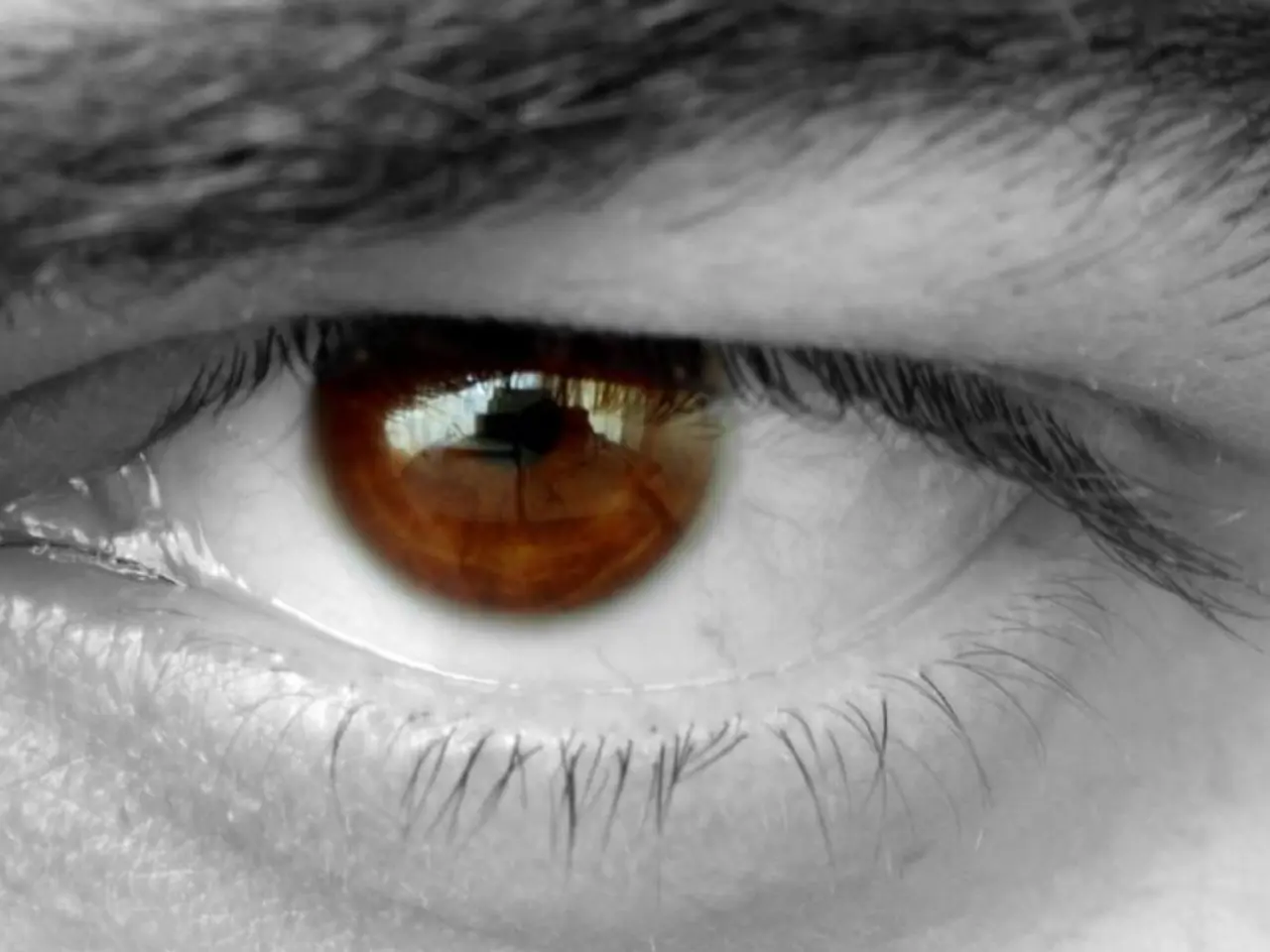
Prevalent Eye Colors and Their Frequencies
In the vast tapestry of human genetics, one trait that has long fascinated scientists and the general public alike is eye colour. This article delves into the complex world of eye colour genetics, exploring the key genes and mechanisms that determine our peepers' hues.
The primary determinant of eye colour is the amount and type of melanin pigment present in the iris. Two genes, OCA2 and HERC2, stand out as the most influential in this process.
The OCA2 gene codes for the "P protein," a crucial player in melanin production. A genetic mutation or "switch" can reduce OCA2 function, limiting melanin production in the iris and leading to lighter eye colours such as blue. This mutation has been traced back to a single ancestor in Europe around 6,000 to 10,000 years ago, shedding light on the common origin of blue-eyed individuals[1].
On the other hand, the HERC2 gene influences eye colour by controlling the expression of OCA2. Variations in the HERC2 gene affect how much OCA2 is expressed, thereby regulating melanin production levels in iris cells[3][5].
Other genes, like SLC24A4, also contribute to melanin synthesis, adding to the complexity of eye colour inheritance[5].
The concentration of melanin in the iris determines visible eye colour. Brown eyes result from a high concentration of melanin in the iris stroma, which absorbs more light. Blue eyes, on the other hand, have very low melanin, causing light scattering (Rayleigh scattering) in the stroma, resulting in the blue appearance. Green and hazel eyes have intermediate melanin levels, with green eyes having some yellowish pheomelanin combined with light scattering, and hazel eyes having moderate melanin with mixed light scatter effects[4].
Melanin in the iris is produced by melanocytes, whose activity level, governed genetically, determines the pigment amount. Thus, genes like OCA2 and HERC2 indirectly regulate how much melanin melanocytes produce and store in the iris cells[2][3].
While most adults maintain their eye colour naturally, it can be altered with coloured contact lenses. Interestingly, people with gray eyes have more collagen in the stroma of their eyes, causing the light to scatter and making the eyes appear gray.
Blue is the second most common eye colour globally, with estimates suggesting that about 8% of people have this eye colour. Around 2% of the world's population have green eyes, and approximately 18% of people in the U.S. have hazel eyes.
Heterochromia, a condition where a person has more than one eye colour, can be caused by various factors, including eye injury, diabetes, swelling due to iritis or uveitis, Fuchs' heterochromic cyclitis, glaucoma, acquired Horner's syndrome, ocular melanosis, iris tumor, Posner-Schlossman syndrome, or Chediak-Higashi syndrome. However, there are no up-to-date statistics on the prevalence of this condition globally.
A fascinating fact is that around 10,000 years ago, everyone on Earth had brown eyes. People with brown eyes may be less likely to develop eye cancer, macular degeneration, and diabetic retinopathy than those with lighter eyes.
In conclusion, genes primarily regulate the amount of melanin synthesized and deposited in the iris melanocytes, which physically determines the eye colour by affecting how light interacts with the iris tissue. Multiple genes influence this complex trait, but OCA2 and HERC2 are the major contributors controlling melanin production in the iris[1][3][5].
[1] Hammond, S. (2018). How blue eyes evolved from a single common ancestor. BBC News. Retrieved from https://www.bbc.com/news/science-environment-44394709 [2] Gong, H., & He, J. (2016). Genetic analysis of eye color in humans. Journal of Human Genetics, 61(8), 527-535. [3] Zhang, Y., Zhang, X., Zhang, Y., & Zhang, J. (2012). Genetics of eye color: melanin biosynthesis, transport, and degradation. Molecular Vision, 18, 1540-1549. [4] Koppenol, W. H. (2015). Eye color genetics: the complex biology behind the iris. Trends in Genetics, 31(11), 661-669. [5] Lipinski, M., & Sobkowiak, A. (2011). Genetics of eye color in humans. Annals of Dermatology, 23(3), 243-248.
- The predictive genes involved in determining eye color, such as OCA2 and HERC2, have garnered significant attention in science, potentially raising interest in exploring other genetic factors that influence medical-conditions like mental health, asthma, or skin-care, in the vast tapestry of human genetics.
- Recent findings reveal that a genetic mutation in the OCA2 gene, which codes for the 'P protein', diminishes its functionality, leading to less melanin production in the iris and lighter eye colors like blue, reminding us of the correlation between genetics and conditions like depression and bipolar.
- As we delve deeper into the science of melanin production and its impact on our peepers, it becomes evident that the interplay of different genes, like SLC24A4 and HERC2, influences various health-and-wellness aspects beyond eye-health; for example, nutrition, fitness-and-exercise, and even mental-health.
- Beyond determining eye color, the melanin pigment plays a crucial role in skin-care, with low levels of melanin in the iris observed in blue eyes, resembling sun-damaged skin or eczema.
- In a fascinating twist, the melanin held within iris melanocytes, so instrumental in eye color, may also act as a protective factor for the rest of the body, possibly reducing the likelihood of developing eye cancer or diabetic retinopathy in individuals with brown eyes, implying a connection between our eye color and overall health.
- The advancements in predictive genetic testing for eye color could contribute to promoting health-and-wellness awareness and encourage individuals to take better care of their skin, fitness, mental health, nutrition, and even eye health by adopting appropriate measures like sun protection, regular exercise, mental health therapy, balanced diets, and regular eye exams.
- Simultaneously, understanding the genetics behind melanin production may pave the way for creating predictive models to plan personalized treatment strategies for conditions like asthma, depression, bipolar, or eczema, based on a person's genetic makeup, revolutionizing the future of medical-conditions diagnosis and treatment.